
By Wasif Mahmood
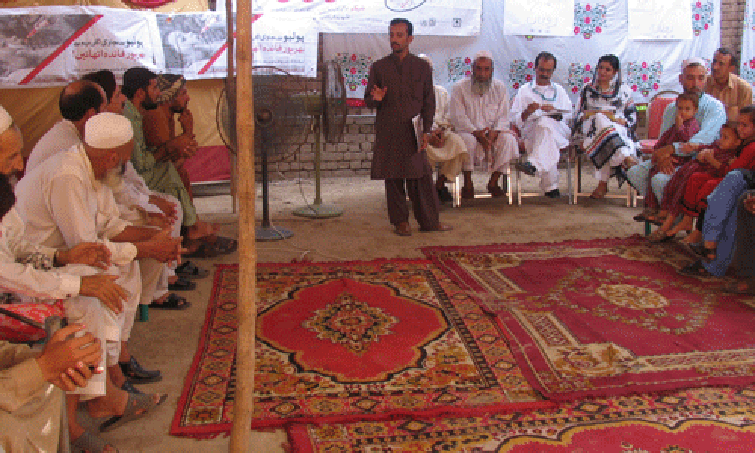
“I realized at an early age that I am paralysed for life by polio. But the trauma has further strengthened my resolve to save other children from this crippling disease”, says Najeebullah Khan, a social mobilizer at an awareness session organised for Pashtuns in Union Council Panj Faiz, in Multan district of Punjab province.
The last polio case in Multan district was detected in October 2009. However, recent samples collected from Kot Abdul Fateh Union Council suggest prevalence of polio virus in its sewage water, sending alerts to the eradication partners, prompting more focused efforts on awareness and social mobilization.
The district has also one of the largest numbers of target children with their number going as high as 7.4 million.
Multan has one of the largest nomadic populations in Pakistan belonging to all backgrounds with over 12,000 Pashtuns. Because of the population mobility and displacement after natural disasters and conflict that keeps them moving and makes their unvaccinated children most at risk.
Pakistan’s battle against polio has been marked with multiple challenges since the formal launch of the Polio Eradication Programme in the country in 1994.The year was disastrous for Pakistan as it reported 25,000 polio cases. Although the number dropped to 56 in 2011, but it still remains the highest number of cases in the world.
Thanks to polio eradication partners and lesser known polio workers like Najeebullah Khan who sweat in the field, sometimes risking their lives, that the number of polio cases has come down to 59 so far in 2013.
“I was one year old when my left leg stopped moving. My parents took me to several doctors and surgeons even to the cities as far as Lahore. I was put to knife by surgeons several times but all operations went in vain. Finally doctors concluded that I have polio”, says Najeebullah addressing the session attended by over a 100 community Pashtun members and their elders.
Najeebullah obtained his Bachelor’s degree in Electrical Technology. His ancestors hail from Bajaur Agency, and migrated to Multan in early 60s due to difficult terrain, cold weather and in search of livelihood. Najeeb’s father who once turned down polio drops to his son now fully supports him in social mobilization efforts for eradication of the disease.
“Polio is only preventable through vaccine. Do not hesitate to take your children to nearby health centres even if the government team does not turn up at your home”, says Najeeb’s father addressing the Pashtuns.
“I still remember the pain when I had to carry my son in my arms and travel to hospitals hoping that he would recover”, says sobbing Nasrullah Khan.
Pakistan has suffered most of the polio cases in FATA and Khyber Pakhtunkhwa with nearly 87 per cent of those children belonging to Pashtu speaking families who are likely to receive fewer dozes of polio vaccine.
Threats by anti-state elements and ban on polio vaccination in North and South Waziristan agencies of FATA has forced the government to abandon vaccination drives in these agencies leaving at least 260,000 million children at risk.
According to national, data thousands of Afghan refugees, internally displaced persons and seasonal workers migrate from Swat, Dir, Balochistan and Afghanistan to South Punjab districts including Multan.
Many of them set up their businesses and started living here permanently. Government with the help of polio eradication partners including UNICEF map their communities and hold sessions with them regularly so that they cooperate with polio teams.
“Life in the agency is difficult in winter. Snow closes down everything in November, December, January and February which causes severe shortage of food and water forcing the families to flee to warmer plains of Punjab”, says Nasrullah Khan.
“Militant violence and subsequent military operations have marred lives of people in Bajaur destroying employment opportunities forcing Pashtuns to stay in Punjab until May so that weather turns pleasant in their respective agencies”, he says.
District health and communication support officer Zulekha Anwar says since the government polio teams lack Pashto communication skills, the Pashtun migrants refuse to receive vaccination from them.
“It is here that Najeeb and his family members come in handy bridging as a facilitator in engagement with priority populations”, she says.
According to Knowledge, Attitudes and Practices study most Pashtun communities are guided by strong traditional values, making outreach to them rather challenging, especially outsiders.
“After doctors discovered that I had polio they fitted a steel boot on my leg to help me recover. Although I continue to live with disability but my life has drawn attention of hundreds of Pashtuns towards polio who cannot afford to ignore the lurking threat around them now”, says Najeebullah Khan.