Ms. Ayesha Raza Farooq
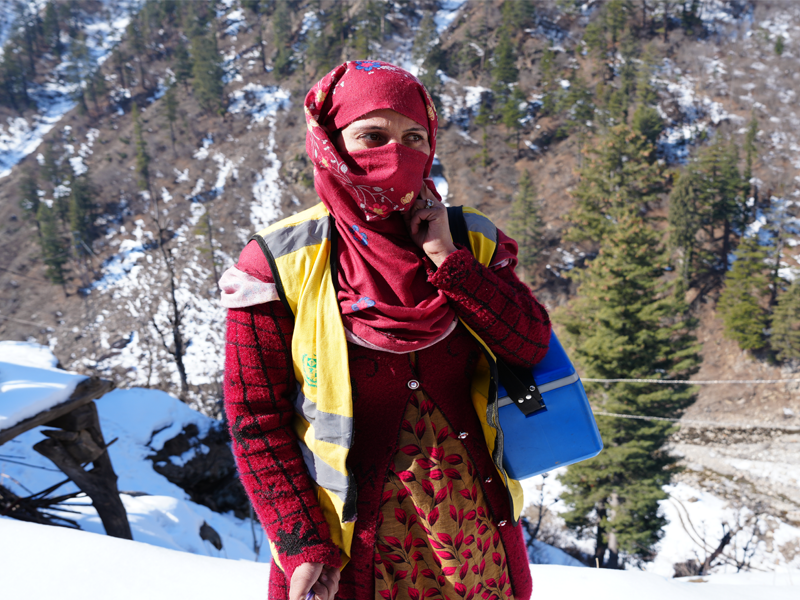
Across Pakistan, over 400,000 frontline health workers travel through bustling cities, remote villages and difficult terrain to protect children from polio. They endure scorching summers, freezing winters and challenging conditions, often walking from door to door to ensure that no child is missed.

Ms. Ayesha Raza Farooq with frontline health workers and health professionals at the Team Support Centre in Lasi Goth, Sindh.
Nearly 60 per cent of Pakistan's polio frontline workforce are women. Their role extends far beyond administering vaccines. They build trust with families, address parents' concerns and help reach children who might otherwise remain unprotected.
Ms. Ayesha Raza Farooq interacts with frontline polio workers.
For Ms. Ayesha Raza Farooq, Prime Minister’s Focal Person for Polio Eradication and a Gender Champion for the Global Polio Eradication Initiative (GPEI), these women are not only essential to delivering vaccines. Their experiences, knowledge and leadership must also help shape the decisions that drive polio eradication.
“Women are the true drivers of this mission,” she says, reflecting on the courage and commitment of frontline workers she has witnessed firsthand.
Women at the heart of polio eradication
During nationwide vaccination campaigns, frontline workers mobilize to protect millions of children across Pakistan, with national campaigns targeting over 45 million children.
For many female health workers, each day brings challenges that go beyond difficult journeys. They engage with families, respond to misinformation, navigate social and cultural barriers, and work to build confidence in vaccination.
Their ability to connect with mothers and caregivers is particularly important in communities where cultural norms may limit interactions between women and male health workers.

Ms. Ayesha Raza Farooq listens to frontline workers, parents and community members during a community engagement session.
“For me, the fight against polio is not only about protecting children's health – it is about equity, opportunity, and empowerment,” says Senator Ayesha Raza Farooq. “Every day, I see how women are driving meaningful change, building trust within communities, influencing decisions, and inspiring the next generation of women leaders. Their contributions are essential to achieving a polio-free Pakistan.”
Pakistan has made significant progress towards polio eradication. From an estimated 20,000 annual cases in the early 1990s, the country reported 31 cases in 2025. Yet Pakistan and Afghanistan remain the two countries where wild poliovirus transmission is endemic.
Reaching every child requires more than vaccination campaigns alone. It demands sustained community engagement, stronger routine immunization services and approaches that respond to the specific barriers faced by women, children and underserved communities.
From frontline participation to leadership
As a GPEI Gender Champion, PMFP Ms. Ayesha is advocating for women's leadership at every level of the polio eradication programme.

Ms. Ayesha Raza Farooq leads a discussion with frontline workers and health professionals.
Her priorities include amplifying the voices and experiences of female frontline workers, integrating gender equality into programme policies and accountability mechanisms, and advocating for women's leadership in health at national and international levels.
“By amplifying their voices and putting gender equality at the center of eradication efforts, we can accelerate progress and ensure no child is left behind,” she says.
For PMFP Ms. Ayesha, meaningful gender equality is not simply about the number of women participating in vaccination campaigns. It is also about ensuring they are heard, supported and represented in the decisions that affect their work.
This means recognizing their frontline experience as valuable knowledge for improving campaign planning, community engagement, worker safety and service delivery.
She has also committed to raising the visibility of female frontline workers through advocacy, storytelling and digital communications, ensuring that their contributions receive the recognition they deserve.
Ms. Ayesha Raza Farooq presents gifts to frontline health workers and participants following a session.
Building trust and strengthening health systems
Pakistan's journey towards polio eradication demonstrates the importance of connecting vaccination efforts with broader health services.
Through the country's Roadmap to Zero Polio, the programme aims to strengthen routine immunization, improve access to essential health services and address barriers that prevent children from receiving life-saving vaccines.
Women are central to these efforts. Their relationships with families and communities can help identify missed children, address concerns about vaccination and strengthen confidence in health services.
Insecurity, misinformation, population movement and gaps in access to healthcare continue to challenge eradication efforts. Gender-related barriers can further influence whether families accept vaccination services and whether frontline workers can safely and effectively reach households.
Ensuring that women participate in programme planning and decision-making can help develop more responsive approaches to these challenges.
As PMFP Ms.Ayesha has emphasized, “When women lead, families and communities thrive.”
A shared responsibility to protect every child

Ms. Ayesha Raza Farooq engages with frontline workers and health professionals during a group discussion.
For PMFP Ms. Ayesha, the commitment to ending polio is both professional and personal.
“As a mother myself, I know there is no greater priority than protecting our children from vaccine-preventable diseases,” she wrote in a World Polio Day article published in Dawn in October 2025.
She believes that ending polio requires collective action from parents, caregivers, frontline workers, teachers, religious leaders, communities, government institutions and partners.
Every child under five must receive polio vaccination during campaigns, alongside the routine immunizations needed to protect against other vaccine-preventable diseases.
“Every door that opens to a vaccinator, every campaign that reaches one more child, brings us closer to a polio-free world,” she wrote.
A seat at every table
This World Polio Day, Pakistan recognizes the extraordinary contribution of frontline workers, particularly women whose dedication continues to bring the country closer to ending polio.
But recognition must go beyond appreciation. Women who help protect children at the doorstep must also have opportunities to influence the policies, strategies and decisions that shape the programme.
For PMFP Ms. Ayesha, the measure of success extends beyond stopping the virus.
“Our success will be measured not only by the eradication of a virus, but by the empowerment of those who make it possible, the women and men on the front lines, and the communities standing behind them,” she wrote.
A polio-free Pakistan will depend on reaching every last child, strengthening trust in vaccines and ensuring that the people who make this progress possible are heard, supported and empowered. Because the women helping protect Pakistan's children deserve not only recognition at every doorstep, but a seat at every table.

Frontline workers, parents and community members participate in a listening session with Ms. Ayesha Raza Farooq.