By Wasif Mahmood
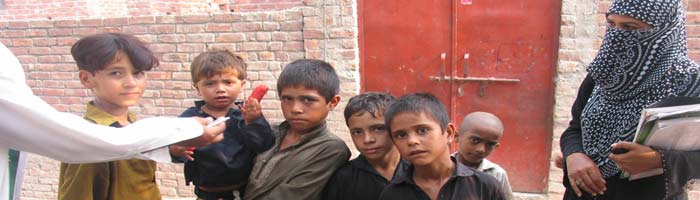
Lahore, 23 July 2013 - A polio team consisting of health workers and Communication Network (COMNet) social mobilizers disperse quickly as a donkey cart loaded with scrap and sacks of discarded books rushes through a mud track.
“Sanga haal day”, asks a Pathan riding on the cart in a frank tone, thus inquiring about ComNet staff administering polio drops with government team members in UC-84 of Lahore, Pakistan, during the sub national immunization drive.
The Union Council is one of the 29 UCs that have been declared high risk for polio. A substantial number of population belongs to the Pashtu-speaking community, which is a priority population for polio eradication since 17 out of 21 children paralysed by polio in 2013 so far are Pashtuns.
Although the population from the area belongs to high risk group, the level of understanding and cooperation shown by them has been heartening.
“Have you given polio drops to my children”, shouts the Pathan in Pashto language as the cart slows down before entering a slum, which has been the hub of Afghan and Pashtu speaking migrants from FATA and Khyber Pakhtunkhwa.
ComNet staff Umair smiles back and nods in affirmative as Pathan disappears in the neighbourhood.
Umair and social mobilizer, Aasia Khalil, like other over 1,400 ComNet staff, have been trained in interactive communication. They go house to house for social mobilization activities and listen to parental concerns. They engage with influencers and leaders and establish trust and community support, and an enabling environment for vaccination teams to operate in.
Both the COMNet staff members have embedded themselves with a polio team going house to house for vaccinating children because it is new and has limited knowledge about the area.
The neighbourhood lacks even basic health and sanitation services, has limited or no access to safe drinking and not even a single public health facility for a population of more than 30,000.
During the campaign Asia proudly displays her necklace which she has received as a gift from an Afghan mother.
“The Afghan women are very courteous and kind to me. They make bead-knitted necklaces which are very colourful and they gift it to me when I visited their home”, explains Aasia Khalil while pulling out a necklace from her bag.
“This little souvenir is a proof of their appreciation of my services for their children and their love for me”, she says.
Since the deployment in January 2012, the refusal conversion rate has increased steadily and is now gradually approaching 70 per cent. In other words, nearly two thirds of refusals reported during campaigns are covered by social mobilizers and vaccination teams.
Area incharge Mehboob Ahmad acknowledges the efforts of ComNet staff members and says they have built excellent rapport with the Afghan and Pathan families.
“There was a time when Pathan colony and other Pashtun-infested areas opposed vaccination and even threatened polio teams. Government teams recorded refusals on a large scale. But after the introduction of social mobilizers refusals have gradually dried up”, Mehboob Ahmad says.
The UC-84 has presence of large number of Pakhtuns and declared polio high risk due to presence of nomads, Pakhtun population, riverine area and positive environmental samples.
The communication and awareness activities with special focus on children has played a vital role to ensure protection of children in Lahore, which saw its last polio case in 2011.
“The UC has been a concern for the spread of the wild polio virus as its presence has been confirmed through sewage samples collected from various parts of city in 2012. In addition poor sanitation facilities, a huge transit and mobile population, has kept the UC on the list of high risk areas. But with the help of our partners on the field we hope to reach children which have not been reached before”, Mehboob Ahmad says.
Pakistan is one of only three polio endemic countries in the world. In 2011, the country reported 198 cases, the largest number in the world. But thanks to significant work and commitment by the Government and partners, the situation improved significantly in 2012 with only 58 cases.